Showing posts with label extinction. Show all posts

22 April, 2015

Government moves to save Victoria’s iconic Leadbeater’s possum

The Hon. Greg Hunt MP, Minister for the Environment
MEDIA RELEASE, 22 April 2015


After carefully considering advice from the independent Threatened Species Scientific Committee
and submissions from experts, interested organisations and the wider community, I have decided to
list the Leadbeater’s possum as a ‘critically endangered’ species.

The Threatened Species Scientific Committee’s recommendation was clear and unequivocal regarding the need to transfer the species from endangered to critically endangered.

This means Victoria’s faunal emblem will now receive the highest level of protection under national environment law.

Leadbeater’s possums have very specific habitat requirements in order for them to survive and flourish. Sadly, almost half of the possum’s ideal habitat – the old-growth mountain ash forest in the Central Highlands of Victoria – was burnt in the 2009 bushfires.

The challenges facing this iconic species are significant. It has undergone very severe population declines in recent decades with numbers having decreased by more than 80 per cent since the mid 1980s.

That is why we will be working closely with the Victorian Government to find a solution which will help save the possum for future generations.

First and foremost, I have already asked my Department to work with Victorian Government officials and commence a review and update of the Leadbeater’s possum draft Recovery Plan. This Plan must be finalised and acted upon.

The Australian Government is already taking significant action to protect threatened species. In 2014, we initiated a new national approach to saving our threatened species with the appointment of Australia’s first Threatened Species Commissioner. Since then, we have invested more than $76 million for practical science-based actions, to turn around species declines.

As an example, the Australian Government is supporting Zoos Victoria to grow habitat for lowland Leadbeater’s possum and helmeted honeyeater populations. Through funding under the 20 Million Tree Programme, the Government will help Zoos Victoria to plant 112,000 trees at Coranderrk

Bushland Reserve which will provide breeding populations of these species with suitable habitat to help their recovery.

In addition, the Australian Government’s National Environment Science Programme Threatened Species Recovery Hub will be investing $30 million over the next six years in practical science and field work to test and explore options to tackle the threats to our native animals and plants.

(ENDS)

16 April, 2015

Victorian state emblem Leadbeater's possum pushed closer to extinction

Tom Arup
The Age, 16/4/15

Victoria's state animal emblem, the Leadbeater's possum, is set to be formally recognised as being on the brink of extinction, leading to the Andrews government fast-tracking a program to identify more colonies of the species.

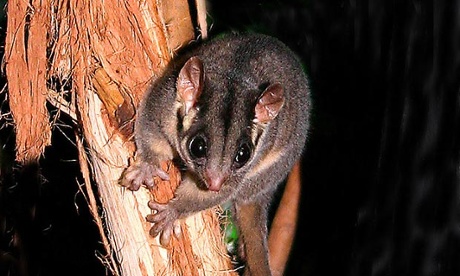
On the way out: A Leadbeater's possum. Photo: Ken Irwin
But the state government has again stopped short of backing a new national park to protect the Leadbeater's habitat, which conservationists and many scientists say is crucial to ensuring the species' survival.

Environment Minister Lisa Neville on Thursday announced measures to find more Leadbeater's through surveys, including infrared aerial mapping of habitat and remote camera surveys in planned logging areas.

It is understood federal Environment Minister Greg Hunt will declare next week that the Leadbeater's formal national threatened species status has deteriorated from "endangered" to "critically endangered", considered the last step before extinction in the wild.

There is no accurate estimate of how many Leadbeater's possums still live in the wild, though government modelling has previously put the range between 4000 and 10,000 with large caveats.

Concern for the species' survival soared after the 2009 Black Saturday bushfires destroyed 45 per cent of its primary habitat in the state's central highland forests, north-east of Melbourne. Conservationists say continued logging of the species' habitat has further increased the pressure.

Hope grew among some environmentalists this week that the impending federal decision on the Leadbeater's conservation status might see the state government give some form of public support for a new national park.

Numerous conservationists and scientists – including Sir David Attenborough and Dr Jane Goodall – have supported a campaign to set up the "Great Forest National Park" in the region, which would encompass much of the highlands forest.

But the area is also one of the state's primary native forest logging areas.

During last year's state election campaign Labor had been expected to support a new national park in some way, but reportedly dumped the policy at the behest the CFMEU, which represents forestry workers.

Instead the Andrews government promised to establish a taskforce of industry, unions and green groups to reach common ground on issues facing forestry, including jobs, economic activity and environmental protection. Ms Neville said the relevant groups were now working on how the taskforce will operate.

"We will consider any reasonable proposals reached by consensus through the industry taskforce regarding the establishment of any new national parks," Ms Neville said.

The new survey program includes fast-tracking targeted searches to identify new Leadbeater's colonies, remote camera surveys by the state-owned timber company VicForests in forest to be cut down, and aerial surveys to identify possum habitat. The state government will also purchase and loan equipment for community surveys.

The surveys follow recommendations by a previous advisory panel, which was led by industry and Zoos Victoria and established by the Napthine government. The Andrews government says it is implementing the panel's recommendations, which did not include a new park and were criticised as being ineffective for the species' survival by environmentalists.

Australian National University ecologist, Professor David Lindenmayer, said: "This is not even Band-Aid stuff. We are dealing with a critically endangered animal in a critically endangered ecosystem. It needs real measures."

Campaigner from MyEnvironment Sarah Rees said the latest survey measures were dangerously close to status quo, "which is what is leading this animal to extinction."

"What we need is an improved reserve design, being the Great Forest National Park, to stop extinction, not a bunch of cameras, a search for habitat that does not exist and an expectation that the community will do the work of paid government personnel," she said.

30 June, 2014

Leadbeater's possum death fuels survival fears

Bridie Smith, Science Editor
The Age, June 26, 2014


A Leadbeater possum at Healesville Sanctuary.
A Leadbeater possum at Healesville Sanctuary. Photo: Justin McManus

Conservation scientists have expressed concern about the genetic health of the last population of lowland Leadbeater's possums, after a fatally diseased possum arrived at Healesville Sanctuary from the wild and died.

It's the third consecutive year that a wild animal, selected because of its apparent health and value to the captive breeding program, has died.

Listed internationally as endangered, the Leadbeater’s possum is Victoria’s faunal emblem.

There are just 40 of the lowland Leadbeater’s left, living in a small patch of forest near the hamlet of Yellingbo, near Healesville.

Melbourne University conservation geneticist Andrew Weeks analysed tissue samples from the lowland possums. The most recent results reveal a 10 per cent slide in genetic diversity over the past decade.

‘’We’ve recorded a loss and that’s quite a concern,’’ he said.

The typical level of genetic diversity in a Leadbeater's possum population is 65 per cent. The diversity level in the Yellingbo population is now 45 per cent.

Dr Weeks said as populations shrank in size, the rate of inbreeding increased and genetic abnormalities could start to show. This included shorter lifespans, fewer offspring, a greater predisposition to disease and a weakened ability to fight disease.

He said while there were 40 individuals living in the Yellingbo Nature Conservation Reserve, 50 kilometres east of Melbourne, it was unlikely that all were breeding. Therefore, the animals contributing to the gene pool was smaller than the population numbers suggested.

The female possum that was brought to Healesville Sanctuary as part of a captive breeding program in May died earlier this month. A post-mortem revealed she had cancer in her reproductive tract, inflammation of the liver and kidney disease.

General manager of life science at Healesville Sanctuary Rupert Baker said the adult male that died in 2013 also had cancer, while the adult female that died in 2012 had a rare blood parasite that vets believe has never before been seen in an Australian marsupial. The deaths have prompted concerns that the population’s gene pool is too shallow to allow for healthy, resilient genetic diversity.

Healesville Sanctuary’s threatened species biologist Dan Harley said the deaths highlighted the precarious position of the wild population - and raised the difficult question as to whether authorities should start to consider bringing the wild population into captivity.

‘’We knew the wild population wasn’t going well numerically but what this says is that it’s probably not going well in terms of its genetic health,’’ Dr Harley said.

When confronted with a similar scenario with the mountain pygmy possum, scientists opted to cross-breed the Mount Buller population with the genetically distinct Mount Hotham population. The hybrid animals were then released into the wild to boost the gene pool at each location.

However it is a last resort for scientists who, where possible, try to preserve distinct groups in the wild.

"We should really only intervene when things are dire," Dr Harley said.

20 March, 2014

Don't give up on Australia's endangered species

David Lindenmayer
The Guardian, 20 March 2014

Endangered: the leadbeater's possum. Photograph: Healesville Sanctuary

Recently, there has been a lot of discussion in the scientific community about whether we should allow some species to go extinct. The argument put forward is that the number of endangered species is so great, it isn’t worth the resources to attempt to save them all. But in a wealthy country like Australia – which has some of the best ecologists, conservation biologists and conservation scientists in the world – it is critical that we do far better in managing the nation’s natural resources. A loss of biodiversity is an indicator of poor environmental management. Suggesting that we should let yet more species go extinct on this continent is too defeatist and does not inform the public about what is needed to solve the country’s biodiversity issues.

The approach to allowing species extinction has been around for some time. It’s called “ecological triage”, whereby limited resources for conservation funding are targeted at the subset of species for which management success is most likely. The approach stems from the same process used in medicine to set priorities for allocating efforts to treat patients. The ecological triage approach is thought by some to be essential because it is believed that many resources are directed to species on the brink of extinction that are doomed in the long run, and too few are targeted at declining flora and fauna that are still recoverable.

As a counter to these ideas of ecological triage, some conservation biologists believe that parallels between emergency medicine and conservation biology are inappropriate. For example, they consider that it makes extinction acceptable and allow decision-makers to get away with allocating insufficient resources to address environmental problems. More than a decade ago, scientists Cameron and Soderquist argued in Nature that nations such as Australia should reject the concept of ecological triage because it is has the knowledge, time and ability to save threatened and endangered species.

My own opinion is that rather than arguing about which species to save and which ones to let go extinct, five key things need to be done.

1. We need to make some general calculations about how much money is needed to adequately conserve Australia’s biodiversity.

2. We must develop the funding framework to support effective conservation and land management efforts. Piecemeal, short-term and underfunded attempts characterise the environmental management arena in Australia – usually with limited success. Large-scale and long-term initiatives like an environmental levy (like the Medicare levy) or a GST on food with the funds directed in land management are possible options. Levies can work and if managed appropriately (and transparently) can raise sufficient funds to solve major problems and spread the burden across all of society to generate a public good outcome.

3. We must identify the management actions and expenditure of resources that will provide the maximum benefit.

4. We need to do the proper management interventions to tackle the processes threatening biodiversity in particular ecosystems – be it limiting industrial clearfelling in the wet forests of Victoria to conserving populations of the endangered leadbeater’s possum, continuing strategic fox-baiting to reduce feral predators and maintaining populations of animals like the eastern bristlebird, or protecting woodland remnants and re-vegetating patches of woodland on farmland to help recover temperate woodland birds.

5. We must do the monitoring so that we can tell what management is working (and then keep it going), and what is not, so that it can be changed. This last step is critical as it essential to show investors – the Australian public – what was the environmental return on the investment.

Debates about letting species go extinct are important to stimulate discussion among the public, policymakers and politicians about the long-term trajectory of conservation. This nation must properly identify the expenditure of resources, management actions and monitoring that will conserve its natural heritage.

30 September, 2013

Possum taskforce seeking a balance

Nick Toscano 
The Age, September 30, 2013

Photo: Ken Irwin  
A taskforce trying to protect Leadbeater's possum from extinction has begun battling the complex challenge of determining how to balance logging and conservation in Victorian forests.

The possum, Victoria's endangered faunal emblem, lost almost half its habitat during the Black Saturday bushfires of 2009, and scientists say the timber industry is putting the rest at risk.

A government-appointed taskforce led by Zoos Victoria and logging leaders is holding meetings on Monday and Tuesday. It will then draft its recommendations on how to support the recovery of the possum while sustaining the financially troubled timber industry.

The media group looking at a 300 year old Mountain Ash, (centre) which has Leadbeater's Possum nesting hollows.

This giant mountain ash has Leadbeater's possum nesting hollows. Photo: Ken Irwin
But critics fear reforms will not go far enough after studies showed the possum has insufficient habitat for long-term survival. Many want a new highlands national park that would protect habitats from further logging.

Forests in the central highlands are the last main home for Leadbeater's possums, but also a primary logging area. Exact numbers of the possums in the highlands are unknown, but are likely to be fewer than 2000.
Australian National University ecology expert David Lindenmayer said logging was the main threat to the species' survival because it reduced habitats and made forests more flammable.

He said 30 years of forest research showed the only way to stall the species' extinction trajectory was to declare a national park.

Victoria's state-owned timber company VicForests said it would strengthen its conservation codes, but locking up the central highlands would be a ''simplistic notion to what is ultimately a complex problem''.

''There are long-term challenges for the possum which would exist if we harvested timber or not,'' spokesman Nathan Trushell said.

07 December, 2012

A state of extinction?


Bridie Smith, Science and Technology Reporter
The Age, December 7, 2012

Bushfires and logging have taken a terrible toll on the habitat of the rare Leadbeater's possum. How long can it survive? Bridie Smith and Tom Arup report.


The critically endangerd Leadbeater possum. Photo: Angela Wylie

THE ground squelches underfoot, the forest a mass of branches criss-crossing between the slender trunks of mountain swamp gum and the ferny undergrowth. This is Leadbeater's possum country. And one of the tiny critters is about to get a rude awakening.

It's late in the afternoon, but for the endangered nocturnal possum it's the middle of the night. Its round black eyes are fully alert by the time it has been scooped from its timber nest box high in a mountain swamp gum and popped into a brown cotton bag.

Still radiating the body heat it has generated and shared with its nest buddies, the young male is weighed and measured at ground level before being returned to his treetop home.

A clear-felled Leadbeater possum habitat in Victoria's central highlands. Photo: Justin McManus
The annual weigh-in, which also gathers genetic data, is a vital opportunity for biologists to check the health of Victoria's faunal emblem and one of the rarest mammals in the country.

But what the surveying scientists are increasingly finding is a species under stress. Fire has destroyed much of its habitat, and conservationists say logging is putting pressure on the rest.

Now there are serious suggestions Victoria is watching its animal emblem head towards extinction. And there are calls for intervention.

After studying the marsupial for more than three decades, ecologist David Lindenmayer gives the possum's survival in the wild just 20 years. ''If we don't seriously look at conserving these intact areas of forest, then that's all we've got,'' he says. ''This is the time to make sensible decisions and go for it.''

At the Yellingbo Nature Conservation Reserve, a small patch of swampy forest is home to the last remaining lowland population. As its habitat shrinks, the past eight years has seen a 40 per cent decline in Leadbeater's possum there. Numbering no more than 60, they are now concentrated in an area measuring just four kilometres by 120 metres.

The situation is not much better for the other, larger, population of Leadbeater's in the tall, cool, mountain ash forests of Victoria's central highlands. Exact highlands numbers are unknown, but are likely to be somewhere under 2000.

On Black Saturday, more than one-third of public land within the Leadbeater's highland habitat range was burnt. Studies by researchers at the Australian National University and the Arthur Rylah Institute for Environmental Research have found that Leadbeater's have not returned. Highland possums like to live deep in hollows of old trees, so young trees tend not to be suitable. Victoria's central highlands are dominated by young forest - 99 per cent of the trees are from 1939 or later - and just 1 per cent of the mountain ash forest is old growth.

Lindenmayer says the front line of the fight to save the endangered species is the mountain forest, and that if the young forest isn't allowed to age, the possum will vanish.

Here lies the problem. As fire and felling shrinks forests, competition for the remaining resources between loggers and conservationists has intensified to such an extent that the petite possum, which weighs no more than an apple, is now a hefty political problem.

''Leadbeater's possum is an iconic species, somewhat like Victoria's tiger or panda,'' says Dan Harley, Healesville Sanctuary's threatened species biologist.

The dilemma facing the state government is that it wants to provide the timber industry with resource security to meet its contracts. That means nominating areas for the protection of Leadbeater's and other threatened species, and allowing logging elsewhere.

Harley says there are some risks to this approach. First, it needs to be established where the possum's stronghold populations are.

''At the moment we are protecting sites based on habitat attributes, which makes perfect sense, but you need to know that the possums are in there and at the moment we don't have that information,'' he says.

Second, protecting some areas invariably leads to others being logged. Clearing these areas puts pressure on those remaining sites - which are still vulnerable to fires, such as those on Black Saturday were.

''What Black Saturday did was wipe out areas you thought were important and suddenly the marginal areas become increasingly significant,'' he says.

Experience points to how precarious possum populations can be. Black Saturday wiped out a Lake Mountain population of about 300, leaving just six individuals in a partly burnt gully, half of which died. The remaining three were taken to Healesville Sanctuary earlier this year, with two still living.

When the 2009 Black Saturday fires swept through the tall mountain ash forest in the central highlands, it was indiscriminate. It burnt 1939 regrowth, 15-year-old regrowth and areas of thick forest that date back to the 1700s.

Studies of the forest after the fires showed that the younger forest burned at a faster rate. While it sounds counter-intuitive, Professor Lindenmayer and his colleagues found that the complexity of older forests which have a dense understorey of wattle and tree ferns slowed the flames down. The microclimate was also more moist and burned at a lower intensity.

Victorian government data suggests the average annual gross area for timber harvest in the central highlands over the next four years will be 3547 hectares. The actual area felled is normally slightly less.

In the Supreme Court last year, conservationists challenged three proposed logging coupes in the central highlands on grounds they contravened protection protocols for Leadbeater's.

Justice Robert Osborn found the coupes did not breach the existing state possum protections. But he added there was strong evidence for an urgent review of areas dedicated to possums because the 2009 bushfires had dramatically changed the landscape.

At the same time there have been lengthy delays in strengthening state and federal government plans to restore Leadbeater's numbers to respond to the habitat loss.

Fairfax Media has obtained drafts of the revised state and national plans for the species dating back to 2009 and 2010, which are yet to be put in place. These plans note the massive reduction in habitat after the Black Saturday fires and put forward 25 measures to better protect the species, costing $4.6 million over five years on early estimates.

Serious concerns about habitat loss are shared by an expert panel dedicated to the recovery of Leadbeater's and made up of representatives of the state Environment Department, Parks Victoria, Zoos Victoria and the scientific community. By late last year the possum recovery team was so agitated by the emerging data on habitat loss that it proposed a moratorium on central highlands logging until better protections were put in place.

But after raising its concerns within the Environment Department the team was told bluntly it could not make such a recommendation and talk of a moratorium ended.

Instead the committee wrote to the department in March, proposing changes to the current state possum recovery plan, including listing logging and future loss of suitable habitat as threats to the species' survival.

The panel also recommends tightening the definition of Leadbeater's habitat and tougher prescriptions for logging operations in the region to slow habitat loss.

''The Leadbeater's Possum Recovery Team is concerned with the rapid and dramatic loss of habitat for Leadbeater's possum that has been exacerbated by the 2009 wildfires,'' the letter says.

Late last year, the Baillieu government sought to boost the flagging forestry industry by allowing VicForests to offer contracts over two decades, up from the previous five-years.

The government also committed to indemnifying VicForests if a contract is broken due to changes in policy, potentially leaving taxpayers with the bill should a future government want to reduce native timber logging.

Lindenmayer says there is not enough in the mountain ash forests to meet contract timber quotas. Logging coupes are in areas that returned to life after the 1939 fires. This, Professor Lindenmayer estimates, is a finite resource which only has another 10 to 15 years left.

''At current rates of cutting, the sawlog industry will be exhausted in 15 years' time. The industry itself is on an extinction trajectory.''

In a paper published in the journal Science on Friday, Lindenmayer writes that the mountain ash are forecast to decline from 5.1 trees per hectare in 1997 to 0.6 trees per hectare in 2070.

And, the Australian National University professor says, there are just 12 months left to implement the drastic changes that are needed to save the possum.

At a briefing for government agencies including Parks Victoria and the Department of Sustainability and Environment last week, Lindenmayer called for a Great Forest National Park to be established in Victoria's central highlands.

Lindenmayer said logging should be reduced by half and the carbon storage capacity of the forest be harnessed by bringing in brokers to establish a carbon offset program involving big business.

Lindenmayer says exit packages should be made available to loggers who have contracts with VicForests - with the proviso that the companies exit for good. He also argues VicForests needs a ''cultural overhaul'' so forest management focuses on the carbon storage potential of the mountain ash rather than treating the trees as a source of timber and pulp.

For its part, the timber industry says logging's footprint on forests is only small and it doesn't log in old-growth forest in the highlands. ''The primary threat to the Leadbeater's possum habitat is not forestry, but fire,'' says Lisa Marty, chief executive of the Victorian Association of Forest Industries.

VicForests spokesman David Walsh says it believes Leadbeater's can co-exist with timber harvesting.

Walsh says VicForests is committed to identifying and protecting potential habitat in areas where logging operations are planned and supports any review of the forest zoning system.

VicForests will factor in the impact of the bushfires on how much they log and from where.

He says medium-term outlooks shows a dip in the availability of highlands timber because of past bushfires. Sales commitments and harvest levels will be managed in line with this.

Victoria's Environment Minister, Ryan Smith, says in response to the debate the Victorian government has begun a $1.86 million project to survey endangered species.

Smith says it will help strike the best possible balance between timber production and the protection of biodiversity.

To date, the main response to the decline of Leadbeater's has centred around a captive breeding program at Healesville Sanctuary.

But the man who each year goes out into the swampy Yellingbo forest to weigh and measure Leadbeater's says the current approach is less than ideal.

Despite being the architect of the captive breeding program, Harley stresses it is not the answer in the crucial mountain forests.

While captive breeding is important, he says, the main game remains habitat conservation.

"Leadbeater's conservation will be won or lost in the mountain forests," he says.

"The foundation stone of everything is to ensure that you've got an adequate amount of high-quality habitat for a species. And if you don't have that, then nothing else you try is going to work."

04 November, 2011

Scars will tell the story

Sue Roberts, Lower Plenty
The Age (letter), November 4, 2011


THE scars will tell the story - of betrayal and loss, of creatures crunched by bulldozers and numbers in their last stand for survival.

Ted Baillieu's hit list

Lynn Frankes, Kew
The Age (letter), November 4, 2011


WHAT else that I hold dear is on Ted Baillieu's hit list? Wind farms, carbon targets and now diminished protection for endangered species and old-growth forests via a sneaky back door.

Back to their roots

Samuel Moore, Hawthorn
The Age (letter), November 4, 2011

THE Baillieu government is stuck in the old-school mode of thinking that says environmental preservation and economic growth are incompatible. Logging native forests has continually lost the state money, so all this proposal is doing is attempting to make VicForests a little less unprofitable than it already is. Relying entirely on plantations, as Gunns is now doing in Tasmania, is the economically rational thing to do and the environmentally obvious approach. If the Liberal government truly lived up to its economic ideology, and didn't let the Nationals run the show, it would stop subsidising an increasingly unprofitable, government-driven native forest industry, and let the competitive advantages of plantations be realised by private industry.


Morally challenged

Andrew Parsons, Ringwood East
The Age (letter), November 4, 2011


WHEN I was a kid facing defeat in a contest on home territory, it was considered unacceptable and morally wrong to simply change the rules to get your own way. Now we see the Baillieu government doing exactly that in response to the landmark ruling in 2010 when the Supreme Court banned VicForests from logging old-growth forests at Brown Mountain in East Gippsland. Environmental laws are designed to protect threatened species and it is not often nature scores a win. But now, by attempting to water down the law and prop up the destructive logging industry, the government is guilty of the unacceptable and immoral behaviour of changing the rules when the outcome is unpalatable. Shame.

A lawless act

Michael Bond, Richmond
The Age (letter), November 4, 2011


IT IS outrageous that the Baillieu government plans to protect the logging industry at the expense of endangered species. Old-growth forests are some of our best carbon sinks, and for the sake of a minority of dwindling logging jobs they will be lost forever, with the wildlife they contain. Massive subsidies keep this industry alive - money that could be better spent. This assault on native forests is environmental terrorism at its finest and appears to be a case of "if you can't beat the law, change it". An outrageous use of Parliament.

A loss now and for eternity

Dave Archer, Frankston
The Age (letter), November 4, 2011

IT IS with much sadness, and not a little anger, that I read of Ted Baillieu's proposal to sacrifice our endangered wildlife and magnificent old-growth forest for some woodchips that we can produce in plantations (''New law in pipeline to aid loggers'', The Age, 3/11). Does Mr Baillieu not care about his grandchildren? None of us will ever see a Tassie tiger again but the long-footed potoroo and other threatened species are still hanging on, just, for future generations to view in the wild and not stuffed in some glass display case, which is where the Premier is proposing to drive them. We need to give these endangered animals and irreplaceable forests a voice. Yes, we need wood products, but we don't need to source them from areas where endangered species live.

Let's not be the generation that oversaw the demise of so much more of our native wildlife, to temporarily sustain an industry in its death throes. These creatures need more protection. Please take a deep breath, Mr Baillieu, think again and do the right thing.

Unethical at best

Sarah Rees, MyEnvironment, Healesville
The Age (letter), November 4, 2011

THE Department of Sudden Extinctions (DSE) has been handed the pen of god to cull threatened species to continue woodchipping native forests. Why? After Black Saturday, the forests were stripped of their capacity to operate duly as a woodchip source and maintain catchment health, but don't let that get in the way of growth. Empowering the DSE to selectively cull threatened species is unethical at best. As for our state's faunal emblem, let's hope Melbourne Zoo can reserve a room for the last Leadbeater's possum - they don't take up much space.

03 November, 2011

New state law in the pipeline to aid loggers

Tom Arup
The Age, November 3, 2011

LOGGERS can seek exemptions from state environment laws protecting endangered species under proposed changes quietly released by the state government.

The proposed amendments to the code for timber production - outlined in a document posted on a government website - hands power to the Secretary of the Department of Sustainability and Environment.

The secretary would be able to exempt a logging project from the requirements of the Flora and Fauna Guarantee Act, which protects the state's endangered and threatened species.

The government has so far released nothing on the proposed changes, but a spokeswoman said last night that there would be sufficient time for public comments on the proposed changes, due February.

The proposed changes follow a landmark ruling in the Supreme Court last year banning VicForests from logging old-growth forest at Brown Mountain in East Gippsland, after an endangered long-footed potoroo was filmed in an area to be felled.

The change will mean proponents of a new logging coupe can make applications to the secretary for exemption.

The secretary will consider, among other things, the numbers required to maintain a viable population of a listed species in the area to be logged, and the amount of habitat near the proposed coupe already protected in national parks.

"Variations to the Code of Practice for Timber Production 2007 are proposed to improve the certainty of timber supply to Victoria's native forest timber industry," the document, dated October 26, states.

"The objective of the variations is to achieve a better balance between the protection of threatened species and sustainable timber production from public native forests."

Wilderness Society campaigner Luke Chamberlain said this was "a sneaky move" by the government to exempt logging from endangered species legislation, and would "betray Victoria's unique wildlife to the chainsaws".

"It puts us on a par with governance of logging practices in Indonesia," he said. "This is world's worst practice of lawless logging."

The Age first revealed in August potential changes to the way endangered species are looked after in Victoria.

At the time, the spokeswoman for Environment Minister Ryan Smith said the Flora and Fauna Guarantee Act was currently not under review.

The government reserved the right to review legislation to ensure that it was current, and fit for the purpose, she said.

Yesterday, the spokeswoman said the changes were to the timber code, which fit under the Conservation, Forests and Lands Act, which was not a legislative instrument.

That was contradicted at the time by parliamentary secretary for forestry, Gary Blackwood, who said the government intended to "revisit or review" the way the law applied to the management of threatened species.

26 January, 2011

Forestry is solution

Shaun Ratcliff, Victorian Association of Forest Industries, Melbourne
The Age (letter), 26 Jan 2011

MURRAY Barson is right (Letters, 25/1): our public forests should be managed on a scientific basis. However, Peter Walsh is correct: Victorian forestry is conducted on a sustainable scale. About 5000 hectares of native forest was harvested last year: 0.07 per cent of the 7.8 million hectares of public native forest in Victoria. Areas are also reserved to protect endangered or threatened species.

The greatest threat to our forests is fire, not forestry. The three landscape-scale fires of the past decade - 2002-03, 2006-07 and 2009 - burnt about 3 million hectares of land. Much of this was native forest.

Forestry is not the problem but part of the solution to managing fire risk. Forestry workers, particularly those in the native forest sector, are based on-location and are skilled and experienced in fire management (thinning, and maintaining fire breaks and roads to ease access to fires) and suppression, and most forestry equipment is useful in firefighting.

Numbers add up

Sarah Rees, Healesville
The Age (letter), 26 Jan 2011

IN THE article ''Minister challenges logging advice'' (The Age, 24/1), Forestry Minister Peter Walsh gives a welcome commitment to examine the status of endangered species in areas exposed to logging.

While the minister appears unaware of the Department of Sustainability and Environment's science up until his appointment, basic skills in maths should make light work of this investigation. Mr Walsh says he ''find(s) it hard to understand how such a small area of logging can have such a big impact''.

Some 70 per cent of the ash forests in this state - the wood the chippers are after and home to many of Victoria's endangered species - is available for logging. Logging is taking out between 2 and 3 per cent of these forests each year.

Given that intensive ash logging has taken place since the 1950s, how many years of logging will it take to reduce 70 per cent of the old ash forest to young saplings incapable of housing hollow-dependent mammals?

Couple this with fires in an average of 40 per cent of the ash forest in national parks and, bingo, you have an extinction crisis.

Extinction state

Phil Alexander, Eltham
The Age (letter), 26 Jan 2011

YOU have to admire Ted Baillieu's environmental credentials: a climate change denier, he puts cattle back in sensitive Alpine habitats and appoints an Agriculture Minister who holds the view that cutting down forests has minimal impact on plants and animals. Maybe our number plates should read: Victoria, the Extinction State.

25 January, 2011

Mind the habitat

Murray Barson, Hurstbridge
The Age (letter), 26 Jan 2011

AGRICULTURE Minister Peter Walsh ''find[s] it hard to understand how such a small area of logging can have such a big impact'' on state forest biodiversity (''Minister challenges logging advice'', 24/1). (One wonders if he is a climate-change sceptic too.)

The man admits his ignorance and should take the scientific advice offered, not hide behind the wasteful procrastination of a departmental study. Habitat destruction is not an easily reversible process.

If the state's timber industry is indeed financially unviable, ''20 years' access … to timber'' only prolongs the agony, but may irrevocably damage the forests.

Vested interests, factional pressures and marginal electorate sensitivities must not be allowed to warp the decision process.