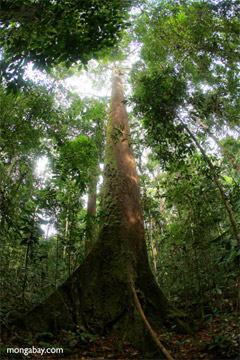
26 January, 2012

World's giant trees are dying off rapidly, studies show

John Vidal, environment editor
The Guardian, Thursday 26 January 2012
Ecological 'kings of the jungle' being toppled by forest fragmentation, severe drought and new pests and diseases
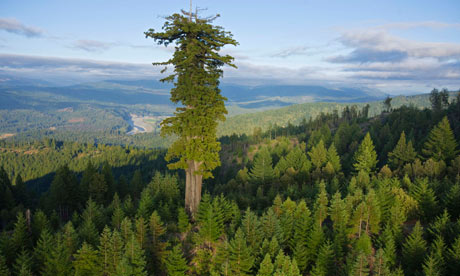
The largest patch of old growth redwood forest remaining in Humboldt Redwoods State Park, California. Photograph: Michael Nichols/NG/Getty Images
The biggest trees in the world, known as the true ecological kings of the jungle, are dying off rapidly as roads, farms and settlements fragment forests and they come under prolonged attack from severe droughts and new pests and diseases.

Long-term studies in Amazonia, Africa and central America show that while these botanical behemoths may have adapted successfully to centuries of storms, pests and short-term climatic extremes, they are counterintuitively more vulnerable than other trees to today's threats.

"Fragmentation of the forests is now disproportionately affecting the big trees," said William Laurance, a research professor at James Cook University in Cairns, Australia. "Not only do many more trees die near forest edges, but a higher proportion of the trees dying were the big trees."

"Their tall stature and relatively thick, inflexible trunks, may make them especially prone to uprooting and breakage near forest edges where wind turbulence is increased," said Laurance in this week's New Scientist magazine.


Big trees may comprise less than 2% of the trees in any forest but they can contain 25% of the total biomass and are vital for the health of whole forests because they seed large areas. "With their tall canopies basking in the sun, big trees capture vast amounts of energy. This allows them to produce massive crops of fruits, flowers and foliage that sustain much of animal life in the forests. Their canopies help moderate the local forest environment while their understory creates a unique habitat for otherplants and animals," said Laurance.


"Only a small number of tree species have the genetic capacity to grow really big. To grow into giants trees needs good growing conditions, lots of time and the right place to establish their seedlings. Disrupt any one of these and you lose them."

In some parts of the world, Laurance said, populations of big trees are dwindling because their seedlings cannot survive or grow. "In southern India an aggressive shrub is invading the understorey of many forests, preventing seedlings from dropping on the floor. With no young trees to replace them, it's only a matter of time before most of the big trees disappear."

According to Laurance, it is not just the biggest trees in the world that are suffering, but also the biggest in their communities. Dutch elm disease killed off many of the stateliest trees in Britain in the 1960s and 70s, and new exotic organisms and bacterial infections, often brought in from other continents via garden centres, are threatening oak, ash and other species.

Longer lasting and more intense droughts, which are becoming more frequent in many tropical areas with climate change, are also taking their toll. Studies in Puerto Rico and Costa Rica suggest that big trees also suffer more in droughts than most other organisms, said Laurance.

"In rainforests droughts promote surface fires that burn through leaf litter on the forest floor. Larger trees were initially thought to survive these fires but in fact many die two to three years later. In cloud forests, big trees use their branches and crowns to rake the mist and capture water droplets. Global warming could push clouds up to higher elevations depriving them of sources of moisture".

"The danger is that the oldest, largest trees will progressively die off and not be replaced. Alarmingly this might trigger a 'positive feedback' that could destabilise the climate: as older trees die, forests would release their stored carbon, prompting a vicious circle of further warming and forest shrinkage," said Laurance.

Many of the big trees are the oldest and most ecologically important inhabitants of the forest. In the Amazon, they are often 400-1,400 years old, in North America giant redwoods can exceed 2,000 years and giant sequoias 3,000 years.

Big trees, like the old-growth forests they inhabit, are declining globally

Rhett Butler
mongabay.com. January 26, 2012

Already on the decline, demise of giant trees may be hastened by global warming.


Already on the decline worldwide, big trees face a dire future due to habitat fragmentation, selective harvesting by loggers, exotic invaders, and the effects of climate change, warns an article published this week in 
New Scientist magazine.

Reviewing research from forests around the world, William F. Laurance, an ecologist at James Cook University in Cairns, Australia, provides evidence of decline among the world's "biggest and most magnificent" trees and details the range of threats they face. He says their demise will have substantial impacts on biodiversity and forest ecology, while worsening climate change.

"To persist, big trees need a safe place to live and long periods of stability," he told mongabay.com via email. "But time and stability are becoming very rare commodities in our modern world."
Giant trees offer critical habitat and forage for wildlife, while transpiring massive amounts of water through their leaves, contributing to local rainfall. Old trees also lock up massive amounts of carbon — in some forests they can account for up to a quarter of living biomass.
Dipterocarp in Borneo
Dipterocarps are commonly targeted by loggers in Southeast Asia. This Dipterocarp was photographed in Borneo by Rhett A. Butler.
But their ability to sequester carbon and render other ecosystem services is threatened by human activities. Some of the world's largest trees are particularly targeted by loggers. The oldest trees are among the most valuable and therefore the first to be cut in "virgin" forest areas.
Big trees are also sensitive to fragmentation, which exposes them to stronger winds and drier conditions. Laurance's own work in the Amazon has shown substantial die-off of canopy giants in small forest fragments. Their susceptibility seems counter-intuitive given big trees' life histories, which invariably include periods of drought and other stress.

"All around the tropics, big canopy and emergent trees are succumbing to strong droughts," Laurance said. "That's been a surprise to me and many other ecologists, because big, ancient trees would have had to survive many droughts in the past."
Forest giants may suffer disproportionately from climate change, writes Laurance inNew Scientist, highlighting research in La Selva, Costa Rica by David and Deborah Clark.
    "Trees are probably getting a double-whammy when the thermometer rises,' says David Clark. “During the day, their photosynthesis shuts down when it gets too warm, and at night they consume more energy because their metabolic rate increases, much as a reptile’s would do when it gets warmer.” With less energy being produced in warmer years and more being consumed just to survive, there is less energy available for growth.The Clarks’ hypothesis, if correct, means tropical forests could shrink over time. The largest, oldest trees would progressively die off and tend not to be replaced. Alarmingly, this might trigger a positive feedback that could destabilize the climate: as older trees die, forests would release some of their stored carbon into the atmosphere, prompting a vicious circle of further warming, forest shrinkage and carbon emissions.
Laurance notes climate change is having less direct impacts on forests, including creating conditions for exotic pathogens to thrive. For example, pathogens such as Dutch Elm Disease, introduced by trade or circumstance, can devastate native forests.
Giant Kapok tree in the Brazilian AmazonGiant Kapok tree in the Brazilian Amazon. Photo by Rhett A. Butler.
All told, the outlook for big trees is not good, according to Laurance."The decline of big trees foretells a different world where ancient behemoths are replaced by short-lived pioneers and generalists that can grow anywhere, where forests store less carbon and sustain fewer dependent animals, where giant cathedral-like crowns become a thing of the past."

25 January, 2012

Forestry stand-off moves north

STAN GORTON 
Narooma News, 25 Jan, 2012

FORESTS NSW has asked police to investigate thefts and vandalism to a logging contractor’s machinery near Batemans Bay over the weekend.

Forests NSW Southern Region manager Daniel Tuan said the thefts of radios, tools, GPS equipment and other material worth thousands of dollars had taken place in Boyne State Forest on Friday night and was discovered on Saturday.

LOGGING AREA: Protestors attached cables to logging equipment in the Boyne State Forest near Batemans Bay. Photo courtesy SEFR

On Sunday night vandals broke into the same four pieces of machinery and set off fire protection equipment.

“These thefts of essential and expensive equipment can be a lasting setback to forestry operators,” Mr Tuan said.

“UHF radios are an essential operating and safety measure.

“Operators of these pieces of heavy machinery have to be aware of each other and visitors to the workplace.

“The GPS equipment is used to help the contractors comply with the exacting operating procedures they work under to ensure they are harvesting in an environmentally sustainable manner.


“The loss of time in replacing this equipment, as well as the cost, is a major impost on their operating budget and a setback to Forests NSW which needs to supply timber to its customers.”

Mr Tuan said the vandalism of the fire protection units was also a risk to operator health and safety in a difficult workplace environment.

Forests NSW is harvesting spotted gum sawlogs from Boyne State Forest for the local sawmill industry.

There is a long history of harvesting in the area.

In solidarity with Victorian conservationists in the Central Highlands, protestors from South East Forest Rescue (SEFR) last week claim to have halted logging operations Boyne State Forest north of Batemans Bay.

The conservation group claims to have found more illegal logging in Compartment 99 and is calling for an end to native forest logging on public land.
Their action saw four logging machines attached by high tensile steel cable to a structure in a tree 20 metres off the ground, and a banner stating “Carbon Criminals”.

Boyne State Forest is part of the National Estate Register, contains records of nationally listed endangered species, as well as state-listed species, such as swift parrots, yellow-bellied gliders, masked and sooty owls.

South East Forest Rescue’s nocturnal fauna survey revealed greater gliders, feather-tailed gliders and sugar gliders as well as micro bats.

SEFR have demanded that the state-run logging agency Forests NSW guarantee there will be no impacts on the environment as a result of the logging and to guarantee any logging Forests NSW and their authorised contractors undertake will not impact on the health and wellbeing of the citizens of New South Wales, being both present and future unborn generations.

“These contractors are repeat offenders,” said Ms Stone, spokesperson for SEFR. “In Dampier State Forest and Bodalla State Forest in the foothills of Gulaga Mountain near Narooma, we uncovered breaches of the licence conditions committed by this contractor.”

“The Office of Environment and Heritage upheld these breaches,” Ms Stone said.

“Old-growth forest, ecologically mature forest, was logged.

Clear felled hillsides are not any form of environmental protection. There are now serious adverse impacts to the many threatened species of the area, and the water catchment

19 January, 2012

Deanmill timber mill workers return

ABC News (Australian Broadcasting Corporation), January 19, 2012

The Shire of Manjimup in south-west Western Australia says the return of workers to the Deanmill timber mill is a significant step forward for the town.

Dozens of timber workers lost their jobs when Gunns Limited closed the mill early last year.

Auswest Timber, which bought the mill in December, switched its saws back on this week, employing 31 new workers.

It plans to employ 20 more when the mill is officially opened in March.

Shire president Wade De Campo says the future of Manjimup's timber industry is looking bright.

"It's created optimism I think in the air of the community," he said.

"Coupled with plans that we have for the timber industry for long-term as a local government, then I think the future is bright in that regard.

18 January, 2012

Logging breaches discovered by conservationists in Yambulla State Forest

MEDIA RELEASE 
18/01/2012

Following the reports on unlawful logging in State forest on the south coast, the conservation group South East Forest Rescue today found more illegal logging in Yambulla State Forest.  This is the third time these type of breaches have been discovered in these particular compartments.

The conservationists are calling for a halt to native forest logging operations.


The compartment contains records of nationally listed endangered species such as Glossy Black Cockatoos, Smokey Mice, Southern Brown Bandicoots, Tiger Quolls, Eastern Pygmy Possums, Bent Wing Bats, Yellow-bellied Gliders, Gang Gang Cockatoos and White-Footed Dunnarts.

Environmentalists used a large wooden tripod attached to a structure in a tree 25 metres high with a person in it to halt logging operations south of Eden on the New South Wales far south coast.

There were four Rocky Outcrops in Yambulla State Forest Cpt 444 that have been logged.  This is unlawful under the licence conditions. (Eden Region TSL regulation 5.11).

“The response from Forests NSW shows the complete lack of regard for the licence conditions that Forests NSW and their contractors must abide by,” said Ms Stone of SEFR.  “The licence conditions for threatened species and habitat conservation are not being adhered to, even though the conditions are grossly inadequate.”

“We have reported the breaches in this compartment to the Office of Environment and Heritage,” said Ms Stone.  “We stated last time that the probability of further breaches in this compartment if harvesting continues is high given that this logging contractor is a repeat offender and that FNSW still is not complying with the licence conditions.”

"These breaches have caused major environmental damage. We have called on the Federal Minister for the Environment to take action.”

“We’re calling on the NSW Minister for the Environment to prosecute Forests NSW without further delay,” she said.  “Verbal and written warnings have been ineffective in rectifying this behaviour nor commensurate with the degree of environmental damage being inflicted upon threatened species habitat.”

"FNSW has had enough chances to get this simple direction right over 13 years and have failed miserably.  The time is over for 'education'. It is now time for the government to get serious and prosecute public
forest offenders of serious environmental damage as they are prosecuted on private land."

Contact Lisa Stone on 0428 640 271

16 January, 2012

Gillard defends new forest deal

ABC News (Australian Broadcasting Corporation), January 16, 2012

Prime Minister Julia Gillard has urged environmentalists to stick with Tasmania's forest peace deal, despite their concerns about a new conservation agreement.

The state and federal governments last week gave Forestry Tasmania approval to continue logging 2,000 hectares of the 430,000 hectares of native forest earmarked for protection.

The Government insists it is necessary for industry to meet existing contracts, but the Greens say it is a breach of the original peace deal.

On a visit to the state, Ms Gillard said it was just an interim agreement until the conservation value of the forest was properly verified.

"The process has been agreed to, Jonathan West was the person agreed to, so I do expect people who have been in that process every step of the way to hold to the process that they agreed to," she said.

"When you read the agreement we always said that we would be guaranteeing wood supply for current contracts and we've done that.

"As a result of the interim conservation agreement Minister Tony Burke signed, 99.5 per cent of the nominated area for interim protection is being protected."

The Greens are disappointed that while in the state, Ms Gillard did not take up an invitation to visit disputed areas.

One protester remains in a 60-metre-high tree-sit.

Greens Leader Bob Brown says members of Still Wild Still Threatened asked Ms Gillard to see the forest first hand.

"She hasn't taken up the invitation from Miranda Gibson, who's sitting 60 metres up in a tree below Mount Mueller in the World Heritage Area," he said.

"[Ms Gibson] has been there for four weeks in a coupe the Prime Minister says would be protected."

10 January, 2012

Taxpayers stump up for logging policy failures

Andrew Darby, Age and Sydney Morning Herald Hobart correspondent
The Age,  January 10, 2012

As $45 million of your taxes is about to be divvied up for broke loggers, a worrying precedent has come to light that raises serious questions about this bailout of a struggling industry.

Attempts by successive federal governments to pay businesses out of the native forest industry in Tasmania have failed to meet basic benchmarks for proper government funding — let alone meet the goal of making the industry more sustainable.

Instead, largesse for new equipment in one program was followed by a more costly exit package to some of the same businesses in the next program.

These failures, by both the Howard and now Labor governments, are being pursued through Senate committees and questions by Greens senator Christine Milne. They are recorded in the dry accounting language of an Ernst & Young investigation into a $54 million Howard government program run by the Federal Department of Agriculture, Fisheries and Forestry.

There’s no question that the island’s native timber industry is in a dire state.  ANU researcher Dr Jacki Schirmer found in a 2010 study for the Forestry CRC that one-third of Tasmania’s forest workers had lost their jobs in the previous two years.  The burdens of the high dollar, global market shifts to certified plantation timber, and environmental campaigns were largely to blame.

When the crisis was gaining pace five years ago, the Howard government established the $54 million Tasmanian Community Forest Agreement Industry Development Program. It handed out 108 grants ranging from $6000 to $10.5 million, mainly to buy new logging machinery or upgrade existing timber plant with the aim of keeping pace with market shifts.

In a pre-election boost from the then forests minister Eric Abetz, the grant winners even gained an extra 30 per cent to compensate for tax.

But in 2008 the federal Auditor-General cast a very cold eye over this program, saying it failed taxpayers, and the department asked Ernst & Young to investigate in 2010.

The Ernst & Young study said department files were so deficient that in 60 cases it could not find the grantees’ own audited income and expenditure statements in support of their applications. That means the files lacked the basic proof that the grantees actually needed a grant. It said that in 29 cases, money was handed over before funding deed requirements were met.

In 26 cases, either there was no confirmation the claim was for an approved purchase, they were given more money than agreed, or there was no tax invoice on file.

This was your money — gone.

After these grants were given out, Tasmania’s native forest industry crashed. To meet this fresh crisis, another $17 million was made available by the Labor government in a department exit assistance program in late 2010.

Comparison of grant awardees in the two programs show that at least five contractors given grants of up to $410,000 for big new logging machines in the 2007-9 program later won up to $825,000 to leave the Tasmanian industry in 2010-11. They had won money to stay, followed by money to go.

A Victorian sawmiller was given $175,000 to build a sawmill in remote Roger River, Tasmania, but only partially completed it, according to the report. The big manufacturer Australian Paper, given $1.48 million for new boilers and paper-winding equipment at its Wesley Vale mill, shut the plant in March 2010.
Following public complaints, the department conducted an investigation into alleged fraud into the 2010-11 program, but did not refer any matters to the AFP.

Now the department is considering applications for the third, $45 million, tranche of aid to the loggers — the Contractors’ Voluntary Exit Grants Program.

There have been 98 applications, and most appear to be treating the taxpayer in time-honoured fashion. According to the department, almost 75 per cent of applications lack enough information for the department to make a final decision.

It says an advisory panel has sought independent financial assessment of applications, which could be finalised ‘‘early in the new year’’.

With the lesson of history on her side, Senator Milne doubts the money will be properly spent. ‘‘To that end I’m calling for an overhaul of DAFF’s internal audit committee so a majority is independent, and secondly, that it is mandatory to apply international auditing standards,’’ Senator Milne said.

A department spokeswoman said it had fully agreed to all of the recommendations made in Ernst & Young’s  report.

But as bailouts go, the lesson here is to watch closely.

Vision for a new Tasmanian forest sector

Tasmanian Country Hour - ABC Rural Australian Broadcasting Corporation, Tuesday, 10 January  2012

The start of 2012 coincides with a new Forestry Tasmania vision for the industry.

Their forestry innovation plan released late last year outlines what they describe as a once in a generation opportunity to re-engineer Tasmania's forest sector.

The plan takes into account the fact that under the intergovernmental agreement there will be less timber available from native forests, at the same time as increasing supplies from plantations.

Forestry Tasmania's managing director Bob Gordon says the market is looking for certified wood products, and in particular, engineered products made hardwood and softwood, and from a mix of native forests and plantations.

Bob Gordon says its about diverting products from the woodchip market, into innovative, engineered wood products.

22 December, 2011

Mill energy plan a step closer

Shauna Black
The Islander,  22 Dec, 2011

WA-Based timber company RuralAus has cleared the first major hurdle in its bid to build a biomass energy plant at its timber mill operations near Parndana.

The company has completed a feasibility study into the project, which aims to generate five to 10 megawatts of power from mill waste, using 2MW for its own operations and making the rest available to other island users.

RuralAus chief executive officer John Ipsen said the feasibility study, completed with a State Government grant, had shown the project should proceed to the next stage and “what we shouldn’t be doing, what technology we shouldn’t use”.

RuralAus will now employ a project manager to get a “bankable project” by the end of this financial year, with completion of the plant in mid to late-2013. It has been encouraged to seek further government grants to support the project to its next level.

“I’m confident the project will happen. There are too many relevant milestones achieved already. We have our own resources, the mill, the government is aware of the island’s energy situation and we have the support of governments,” Mr Ipsen said.

“We just need to get in there and tick all the boxes.”

He said RuralAus was ready to work on the cable and infrastructure issues with stakeholders.

“We see this project as complementing other initiatives, such as Island Energy. We are keen to work with other government and community groups in a whole-of-island approach.”

Meanwhile, RuralAus has interim planning approval to operate the mill at Parndana on a trial basis one day a week.

“We’ve already employed 8 people and we hope to increase that to 30,” Mr Ipsen said.

British firm blacklists Tasmanian timber

Conor Duffy, Environment Reporter 
ABC AM by December 22, 2011


PHOTO: The UK company says it only wants to buy timber produced in a responsible manner. (ABC News)

The Prime Minister's peace deal was supposed to end decades of conflict in Tasmania's forests but protests are continuing.

Now, a London company is boycotting timber products from the island state.

Last month it emerged timber from Tasmanian forests was being used on London Olympic building sites.

The purchaser of the timber products says it will no longer buy the Tasmanian timber from Ta Ann products due to lobbying by activists.

That has infuriated the company, industry and the State Government.

Tim Birch from Markets for Change was among the environmentalists who flew to London.

"Our investigations working with environmental groups in Tasmania clearly has shown that Ta Ann continue to source products coming from these vital forests, and so we went to London to visit a number of companies to inform them of exactly what was happening."

While the Prime Minister's peace deal does say there should be no logging in these forests, the areas are still being assessed to determine if they are actually high conservation value.
Forestry Tasmania says that under the deal it is allowed to keep logging in these areas to supply Ta Ann.
Nevertheless Ian Attwood, the managing director of International Plywood which bought Ta Ann's timber for the Olympics says his company is now boycotting Ta Ann's products.

"The reason we've stopped or we've suspended purchasing from Ta Ann is mainly because of the controversy around the logging in Tasmanian forestry," he said.

"The NGO's will have to be happy with any changes that they can make to enable the product to be purchased by us again."

Mr Attwood says he was concerned by what he heard from two activist groups: Markets for Change and the Huon Valley Environment Centre.

"We're not there to, you know, to savage the forests. We're here to try and buy product in a responsible manner."

That is hotly contested by Forestry Tasmania, Ta Ann and the Tasmanian Government.

The company's products are certified as sustainable under the international PEFC scheme.

Misrepresented
David Ridley from Ta Ann is overseas, however his manager Greg Hickey says the company's practices have been misrepresented.

"It is concerning that they're going and targeting our customers, mainly because of the certification that we have which points to our environmental credentials."

"Our real concern is that if our customers don't buy from us then they're going to buy from potentially illegally-logged sources."

Ken Jeffreys from Forestry Tasmania has attacked the green groups for targeting Ta Ann's customers.

"We're talking about a situation here that is reminiscent of the 1930s, where if you didn't pay protection your shop was burnt the next day."

"Now the same is occurring today. The activists go these companies, they say unless you do what we want, we're going to blackball your products."

AM also has a letter Tasmania's Deputy Premier Bryan Green wrote to International Plywood urging them to continue buying timber from Ta Ann.

Mr Attwood says he found the arguments of the activists more persuasive.
Clearly the battles of the past are far from over despite the forest peace deal.

MEDIA RELEASE: Ta Ann Tasmanian Native Forest Veneer Rejected By UK Market

Markets for Change, 22 December 2011

International Plywood, a major UK importer of plywood from Ta Ann’s Tasmania operations has told the Australian ENGO Markets for Change that they will not be purchasing any more timber from Ta Ann while the controversy around ongoing logging of Tasmania’s High Conservation Value (HCV) and old growth forests continues.

“Markets for Change is encouraged that the international market is so concerned about the ongoing destruction of Tasmania’s high conservation value forests that International Plywood from the UK has taken the decision to no longer buy Ta Ann Tasmania’s plywood product. It is significant that even though Ta Ann had PEFC (1) certification for this product the market has still rejected it as it is sourced from such valuable forests,” said Tim Birch CEO of Markets for Change.

Markets for Change (MFC) recently released detailed research tracking Ta Ann veneer timber from Tasmania’s high conservation forests through Malaysia to London and a sports hall to be used in training by Team USA during the 2012 London Olympics. (2)

Detailed analysis by Market for Change’s partner NGO in Tasmania (Huon Valley Environment Centre) has clearly shown that Ta Ann Tasmania’s operations continue to receive wood products coming from high conservation value forests in Tasmania. These forests have already been earmarked for protection by the Inter Governmental Agreement (IGA) in Tasmania, yet they continue to be logged. (3)

“This decision by International Plywood sends a clear message to Ta Ann that their association with the destruction of Tasmania’s high conservation value forests is bad for business. Ta Ann can no longer claim that their veneer product is sourced from plantations and sustainable regrowth forests. They must take immediate steps to remove identified high conservation forests from their supply chain,” said Will Mooney from Huon Valley Environment Centre.

Following the release of this research Markets for Change contacted a number of UK companies involved in the supply of Ta Ann Tasmania veneer plywood to the UK market. International Plywood UK were surprised when evidence was provided by MFC and Huon Valley Environment Centre showing Ta Ann Tasmania were sourcing wood products from high conservation value forests as they were under the clear impression that they were purchasing wood products from Ta Ann that came from plantations. Even a recent letter from the Deputy Premier of Tasmania, Brian Green to International Plywood UK urging them to continue buying from Ta Ann Tasmania did not persuade the company to continue purchasing veneer plywood from Ta Ann Tasmania.

Markets for Change will continue its campaign, nationally and internationally, to urge the market to reject wood products coming from High Conservation Value forests and instead trade in wood products sourced from ecologically responsible plantations.

Markets for Change is committed to supporting an Australian forest industry based on well managed FSC certified plantation products. Such a plantation based timber industry will ensure long term secure jobs for workers and the protection of native forests.

NOTES
1.    The Programme for Endorsement of Forest Certification (PEFC) has been widely criticised by international environment groups as it is not an indicator of acceptable environmental standards and does not safeguard high conservation value from ongoing logging.

2. http://www.marketsforchange.org/2012-olympics-timber/

3. http://www.scribd.com/doc/72216112/Ta-Ann-Final-Report-2011-Web

Mill energy plan a step closer

SHAUNA BLACK
The Islander, 22 Dec, 2011

WA-Based timber company RuralAus has cleared the first major hurdle in its bid to build a biomass energy plant at its timber mill operations near Parndana.

The company has completed a feasibility study into the project, which aims to generate five to 10 megawatts of power from mill waste, using 2MW for its own operations and making the rest available to other island users.

RuralAus chief executive officer John Ipsen said the feasibility study, completed with a State Government grant, had shown the project should proceed to the next stage and “what we shouldn’t be doing, what technology we shouldn’t use”.

RuralAus will now employ a project manager to get a “bankable project” by the end of this financial year, with completion of the plant in mid to late-2013. It has been encouraged to seek further government grants to support the project to its next level.

“I’m confident the project will happen. There are too many relevant milestones achieved already. We have our own resources, the mill, the government is aware of the island’s energy situation and we have the support of governments,” Mr Ipsen said.

“We just need to get in there and tick all the boxes.”

He said RuralAus was ready to work on the cable and infrastructure issues with stakeholders.

“We see this project as complementing other initiatives, such as Island Energy. We are keen to work with other government and community groups in a whole-of-island approach.”

Meanwhile, RuralAus has interim planning approval to operate the mill at Parndana on a trial basis one day a week.

“We’ve already employed 8 people and we hope to increase that to 30,” Mr Ipsen said.

21 December, 2011

Loggers are clearing bushland at rising rate

Ben Cubby
Sydney Morning Herald, December 21, 2011


Soaring numbers ... an area equivalent to 138,400 football fields was cleared in NSW's bushland last year. Photo: Pat Scala

THE amount of bushland being cleared by logging in NSW soared last year to the highest level since state-wide records began in 1988.

An area equivalent to 138,400 football fields was cleared for crops, forestry or infrastructure, says a government report.

The Office of Environment and Heritage said the rise in logging was probably cancelled out by regrowth, leading to no net loss of trees, though its most recent survey took place in 2008, before the land clearing spike. It said the reasons for the logging increase were unclear.

"[The] most likely factors relate to market demand and favourable climatic conditions and [they] can be expected to fluctuate over time," a department spokesman said. "It is also possible that recent changes in forestry methods are more readily detectable by satellite monitoring."

Environment groups said the annual vegetation report was evidence that logging companies were operating in an unrestrained manner.

Bushfires remain the biggest destroyer of forests in the state, leading to a net loss of 48,300 hectares in 2010, the report said.

But logging activities now come a close second, accounting for the removal of 42,700 hectares of trees in 2010. This is up from 31,000 hectares the previous year, and an average of about 21,000 hectares a year since 1988.

About 21,200 hectares of bushland was cleared in 2010 to make new areas for crops and grazing, while 5300 hectares were cut down to make way for roads, factories and housing.

"The NSW government is currently conducting a review of native vegetation controls," said the chief executive of the Nature Conservation Council of NSW, Pepe Clarke. "They should take this report as a warning - what is required are stronger land- clearing laws that do more to protect the environment, not weaker ones."

The Wilderness Society said the government had "failed in its promises to restrain land clearing, resulting in rapid and accelerating degradation of wildlife habitat and water catchments."

The most recent State of the Environment report found that there had been no net loss of "woody cover" across NSW between 2003 and 2008.

"This is because, although clearing has occurred over that period, there has also been an equivalent amount of regrowth including government sponsored environmental and forestry planting programs conducted by private landholders and state forests, within crown forests areas," the department said.

"Notwithstanding no net loss over the whole state, some regions have experienced net declines in woody cover."

The report uses the international definition of "woody cover", which includes land at least 20 per cent covered by the crowns of trees higher than 2 metres, a description which would include relatively open country.

The introduction of a satellite monitoring system for land clearing last year appears to have increased the level of prosecution for illegal land clearing on private property. On crown lands, the number of prosecutions has increased threefold, from a low base, since 2007.

In 2010, the government received 471 reports of suspected illegal land clearing.

20 December, 2011

MEDIA RELEASE Rainforest case - logging ban extended to January 2012

Jill Redwood, Environment East Gippsland

The East Gippsland rainforest case will be adjourned today, with the temporary halt to logging extended until late January.

"This is a good outcome", said Jill Redwood from Environment East Gippsland. "Our lawyers have filed some very impressive court documents to show that the forests are within the boundaries of a National Rainforest Site of Significance."

"We look foreword to going to court in January, to seek permanent protection for the forests."

"It is just incredible that in this day and age, that a small local environment group has to take on a government agency to prevent the illegal logging of a National Rainforest Site of Significance. Most of the developed world knows the value of forests and rainforest, but the Baillieu government doesn't."

For comment: Jill Redwood - 03 5154 0145

17 December, 2011

Parker moves to amend NSW logging laws

NSW political reporter Mark Tobin
ABC News (Australian Broadcasting Corporation), Updated December 17, 2011 


New South Wales Environment Minister Robyn Parker is moving to amend laws which will allow Forests NSW to harm the endangered population of the yellow-bellied glider on the state's far south.

The documents show Ms Parker is planning changes to the Threatened Species Conservation Act which "authorises harm to the endangered population of the yellow-bellied glider of the Bago Plateau".

Opposition environment spokesman Luke Foley says it is disgraceful.

"Robyn Parker said logging protects koalas, she is now moving to allow logging of habitat of endangered yellow-bellied glider," Mr Foley said.

"The yellow-bellied glider is facing the very real risk of extinction and the NSW Environment Minister is doing everything she can to wipe out this endangered Australian marsupial."

In 2008 the NSW Scientific Committee warned the yellow-bellied glider is "facing a very high risk of extinction…in the near future".

Ms Parker has dismissed the concerns.

"An amendment has been made to reflect updated information about the habitat preferences of the yellow-bellied glider," she said in a statement.

“This amendment restricts Forests NSW logging to areas of low quality yellow-bellied glider habitat on the Bago Plateau.

"Logging in areas of medium and high quality habitat is prohibited until a scientifically rigorous population management plan has been signed off by the EPA.”

16 December, 2011

MEDIA RELEASE: SEFE Pellet factory invalid

South East Forest Rescue, 16/12/2011

In an unprecedented court case South East Forest Rescue took an action against South East Fibre Exports (SEFE) and Bega Valley Shire Council in the NSW Land and Environment Court two weeks ago for building a factory that makes wood pellets from native forest trees.  SEFE is a joint venture between Nippon Paper Industries Co Ltd and Itochu Corporation.  SEFE operates the woodchip mill near Eden and is a major exporter of woodchips which come from forests from Nowra out to Tumut down to East Gippsland in Victoria.  Wood pellets are commonly used to fuel wood-fired power plants.

Bega Valley Shire Council granted the development consent in June, despite much opposition from the community, despite the factory being much bigger than the application originally stated and despite being advised by SEFR that if the council consented they would be in breach of the law.  SEFR also advised SEFE on the day of consent not to begin building the pellet factory as SEFR would be taking legal action.

The court case began on 2 September.  The decision handed down on Friday stated that the pellet factory, which has already been built despite being warned not to proceed, has been invalidated.

It was found that Council did not consider the public submissions, the principles of ecologically sustainable development and the zoning of the land.  The Court’s decision reveals an arrogant approach by BVSC which has now been revealed as unlawful. This means that South East Fibre Exports must not operate the factory or process wood for it.  Any action SEFE take from here will be deemed unlawful.

“This case is important in that it is the first time in thirteen years that the public has been able to bring an action in a NSW court against the woodchipping industry,” said Ms Lisa Stone, spokesperson of South East Forest Rescue.  “It’s an amazing win and a great decision.”

The public are tired of the woodchipping industry being a law unto themselves.  Further the local government and the State government have been co-opted into this corruption of due process.  This case shows that any decision maker must take the public wishes and the principles of ESD into account.

Burning native forests for electricity or using them for wood pellets is one of the greatest threats to the forests of the world.  The Commonwealth government has announced that forestry will have to start accounting for its greenhouse gas emissions but that wont happen until at least 2015.

“The time for waiting is over, the time has come to follow New Zealand’s lead, honour Australia’s international obligations and end native forest logging altogether,” said Ms Stone.  “The protection of our native forests is of urgent national and international importance in these times of global climate crisis.  It’s time to prove that political will is not extinct and put an end to native forest logging, for us and our children's future.”

For more information contact Lisa Stone on 0428 640 271

15 December, 2011

Logging stoush heads to court

Adam Morton
The Age, December 15, 2011


VicForests have been accused of logging a protected site of significance for rainforests. Photo: Rob Homer

VICTORIA'S newly empowered state-owned timber agency is facing a legal writ over claims it is illegally logging protected stands of rainforest in the state's far east.

Conservation group Environment East Gippsland has filed a writ in the Supreme Court accusing VicForests of logging a protected site of significance for rainforests. VicForests is contesting the claim, and has given the court an undertaking it will not log the disputed area before a hearing on Tuesday.

The writ comes a day after the Baillieu government released a plan that significantly expanded VicForests' authority.

In a short hearing yesterday, Environment East Gippsland submitted government maps showing the area was protected as a site of national importance.

VicForests told the court it accepted that the maps were from a government website, but said they were out of date. It said a review of the boundaries had moved the border of the protected area. The Department of Sustainability and Environment backed VicForests' statement. ''The northern boundary of the site has not been updated in the biodiversity interactive maps available on the [department] website. This is being corrected,'' spokeswoman Brigid Ennis said.

Environment East Gippsland secretary Liz Ingham said the explanation was ''suspiciously convenient''.

A spokeswoman for Agriculture Minister Peter Walsh said the court would determine whether the action against VicForests was warranted. ''It is unfortunate that in the court of public opinion VicForests is rarely granted the presumption of innocence,'' spokeswoman Stephanie Ryan said.

The latest court challenge to the timber industry follows days of protests holding up workers in the disputed area. Environment East Gippsland last year won an indefinite injunction over logging about 100 hectares of native forest at Brown Mountain, near Orbost, after its campaigners showed that it was home to endangered species.

Mr Walsh this week released a timber industry plan designed to guarantee a long-term future for the native forest industry, including boosting the length of timber contracts from five to 20 years. VicForests was given sole responsibility for calculating how much timber can be sustainably harvested. It will be monitored and audited by the Department of Sustainability and Environment.

LETTER: Reality bites - dirty power plants and more logging

Nick Jans, Marysville
The Age, Letter, 15/12/2011


JUST as we were deriving some meagre encouragement from the Durban talks, along come our governments to bring us back to reality (''Dirty power plant rules abandoned'' and ''Timber gets long-term commitment'', The Age, 14/12).

LETTER: A confidence boost

Gary Demby, Toolangi
The Age, Letter, 15/12/2011


PROVIDING longer-term contracts to customers of VicForests will surely help build business confidence in much of Victoria. For decades state governments have reduced the amount of forest available to the industry. Sometimes this was for ecological reasons based on good science. Sometimes it was for political reasons. This plan, from what I can tell, will not increase the amount of forest available to the industry. What it will do is provide a clear and effective regulatory framework for forest management and wood supply. We also have to recognise that the forest and wood products industry is largely a manufacturing industry, exposed to the high Australian dollar and cheap imports. As the seventh most forested nation in the world, it is a joke we have a $1.9 billion trade deficit in wood and paper products. Hopefully this policy helps fix this.


JUST as we were deriving some meagre encouragement from the Durban talks, along come our governments to bring us back to reality (''Dirty power plant rules abandoned'' and ''Timber gets long-term commitment'', The Age, 14/12).
Nick Jans, Marysville

LETTER: Path of destruction

Kath Angus, East Brunswick
The Age, Letter, 15/12/2011


BRAVO, Baillieu. You have surpassed even my wildest expectations with your disregard for our ecosystems and the species endemic to them with your new forestry plan. Not only does it prove your unwavering dedication to the destruction of Victoria's native forests, it shows you have no desire to move towards a sustainable future. Not even Victoria's faunal emblem will have a place in Victoria. I will, however, compliment you on coming through with your transparency. With VicForests taking ''sole responsibility for calculating the amount of timber that can be sustainably harvested'', corporate control of our government could not be clearer.

LETTER: Propping up jobs

Dean Wotherspoon, Northcote
The Age, Letter, 15/12/2011


THE latest timber industry plan basically turns the native timber industry into an expensive social security system to help prop up jobs in a handful of National Party seats. It appears that the limited environmental controls over logging and protection of biodiversity are to be wound back, and that Agriculture Minister Peter Walsh is even considering allowing some types of logging (thinning operations) into national parks. Given the non-compliance with environmental regulations these thinning operations have recorded in recent years, it is unbelievable that any competent minister would extend such operations in national parks. This policy is further evidence of the government's anti-environment stance.

LETTER: Environmental policy a betrayal of Liberal legacy

Damian Magner, Montmorency
The Age, Letter, 15/12/2011

SAFEGUARDS for the protection of Victoria's natural environment have been in decline since the Baillieu government was elected and now the destruction is set to get worse (''Timber gets long-term commitment'', The Age, 14/12). It is clear the National Party is driving environmental policy in this government. Poor old Environment Minister Ryan Smith has been put in a box while the National Party runs riot. Some of the best conservation gains in Victoria were as a result of the vision and leadership of the Hamer Liberal government in the 1970s. Ted Baillieu is trashing his mentor's legacy because he is dependent on the National Party to hold government.

14 December, 2011

LETTER: Government should get out of logging business

Peter Campbell
Letter to the editor (not yet published), 14 December 2011

Local conservationists have yet again had to take court action and use blockades to stop VicForests, the Victorian Government's logging business, from logging protected rainforest in East Gippsland.

VicForests have form. They were found guilty of breaking the law relating the protection of endangered species in Brown Mountain's forest in the Supreme Court in August 2010.  Over a year later, despite a court order, they are yet to pay the court costs awarded against them to Environment East Gippsland.

In July this year, VicForests started logging forest near Sylvia Creek that is home to Leadbeaters Possum. They were stopped by another court order following legal action initiated by local environment group MyEnvironment.  This court case, scheduled to be heard early next year, is again about VicForests ignoring the laws concerned with protecting endangered species.

The Baillieu government's response to VicForest's illegal and unethical practices is to reward them with 20 year contracts for logging our remaining native forests, indemnify their contracts, allow them to determine the amount of forest they can log and allow them to log forests in reserves, parks and water catchments.

The Baillieu government has also flagged changing the Flora and Fauna Guarantee Act so that a bureaucrat can exempt VicForests from complying with it, thereby allowing them to log forests that are and should be protected.

The native forest logging industry is in terminal decline. Regional Forests Agreements have failed. The global market for woodchips, the major "product" that comes from out native forests, has collapsed.  Despite accelerating logging, jobs continue to decline.  The industry is largely automated now.

The wholesale conversion of native forests into plantations by continued logging and burning is simply not sustainable, as scientists such as Professor David Lindenmeyer have stated.

There is enough plantation resource available in Victoria right now to supply our timber and pulp needs.  The Victorian government should get out of the logging business, get rid of VicForests, and support our sustainable plantation-based timber and wood products industries.

Our native forests should be protected for the carbon they store, their biodiversity, their function as water catchments and because they are wonderful places to visit.

Un-sustainability confirmed at last

Sarah Rees, Director, MyEnvironment Inc.
Letter to the editor (not yet published), 15/12/2011

The sustainability report has finally been done on VicForests operations in Minister Peter Walsh's timber 'ACTION' plan. The whole lot is unsustainable - if  it was 'sustainable' then we wouldn't need to log parks, reserves and special protection zones.

Every logging operation is now in breach of our international treaty with the UN Convention on Biodiversity, the Montreal process and Heads of Commonwealth Agreement. Thank you Minister, we have been waiting for this finding! Now we have proof directly from those in charge.

MEDIA RELEASE: Supreme Court orders stop to logging East Gippsland rainforest

Environment East Gippsland presented the Court with official Victorian Government maps to show that the disputed area is a protected National Rainforest Site of Significance.  VicForests submitted that the maps were wrong, and that the government department was scrambling to move the boundaries on the official maps before Court resumes next Tuesday 20 December 2011.

"It's a huge win for the forests today", said EEG secretary Liz Ingham who attended the court. "The Court stopped the logging in the nick of time, to prevent a rainforest reserve being logged."

"VicForests blamed the government, saying the rainforest reserve maps were wrong. This is a suspiciously convenient excuse", she said.

"For a very long time, the government has presented the public with rainforest reserve maps. They didn't alter the reserve boundaries when VicForests moved in to log the reserve.  They only decided to move the reserve boundaries after our non-profit community environment group took VicForests to court. How convenient.  VicForests is a state-owned enterprise with Premier's brother in law on the Board."

"Up here on the ground, those blockading this area hung on for their lives in the forest waiting for the result. They are absolute forest heroes", said Ms Redwood.

The case returns to Court on Tuesday 20 December at 10.30am, at which time the Court will address a further halt to logging.

For comment: Jill Redwood - 5154 0145 / Liz Ingham 0409 333 595

Timber gets long-term commitment

Adam Morton and Tom Arup
The Age, December 14, 2011


THE government has moved to guarantee the long-term future of Victoria's timber industry, ending decades of protection of native forests from logging.

A new timber industry plan substantially boosts the power of VicForests, the government-owned commercial timber agency that the previous Labor government planned to abolish.

VicForests will take over sole responsibility for calculating the amount of timber that can be sustainably harvested, and will determine when and where logging takes place.

Advertisement: Story continues below
Forestry companies will be offered native timber contracts lasting 20 years, up from the current maximum of five - a step to encourage investment in new mills and equipment.

The government will also indemnify VicForests against the cost if a contract is broken due to changes in policy, potentially leaving the state with the legal bill should a future government want to reduce native timber logging.

Other proposed changes include allowing ''ecological thinning'' of forests in reserves, parks and water catchments, and a review of timber legislation.

Agriculture Minister Peter Walsh said there were no plans for the amount of native forest harvested to increase, and that ecological thinning would be restricted to existing logging areas. He said Victoria's native forest timber was a ''magnificent and renewable resource'' with the potential to support a vibrant long-term industry.

''There is absolutely nothing sinister in this,'' he said. ''It is about, in the areas that were going to be logged, giving certainty to the industry and making sure forests are managed appropriately.''

The plan fulfils a Coalition election commitment. It comes two months after the release of proposed regulation changes that would give the head of the Department of Sustainability and Environment the power to grant loggers an exemption from endangered species laws.

Mr Walsh said yesterday that it was no secret VicForests had problems in the past, but it had undergone substantial change.

He said the Department of Sustainability and Environment would continue to watch VicForests' work.

Australian Conservation Foundation campaigner Lindsay Hesketh said there was a conflict between giving VicForests greater power and protecting the environment. ''It appears this is the same thing that happened with Forestry Tasmania and led to the disaster Tasmania has become,'' he said.

Wilderness Society campaigner Luke Chamberlain said the plan to lock in compensation payments if a future government changed policy was ''agricultural socialism from the Soviet era''.

Opposition agriculture spokesman John Lenders said the plan failed to balance the need to protect the environment and secure jobs.

AM - Victorian government unveils new timber industry plan

AM, TONY EASTLEY
ABC Radio, 14/12/2011 

TONY EASTLEY: A leading ecologist has described the Victorian Government's new plan for the timber industry as 'medieval'. And conservationists say it opens a way for logging in national parks.

However, the plan to open up parks and reserves to logging and extend the length of logging contracts has delighted the timber industry, which says it brings much needed security and certainty.

Simon Lauder reports.

SIMON LAUDER: Australian National University ecologist David Lindenmayer has spent 28 years studying Victorian forests.

Professor Lindenmayer says they've been over exploited for decades and the Victorian Government's new Timber Industry Action Plan could be their death knell.

DAVID LINDENMAYER: We're going to see the extinction of Leadbetter's Possum probably within 30 years. We're going to see forests made more fire prone. We're going to see major complications with Melbourne's water supply.

SIMON LAUDER: At the moment the state government's forestry arm, VicForests, can only give companies access to timber for five years.

Victoria's agriculture minister, Peter Walsh, says that doesn't give the timber industry enough certainty to invest in the future and the government plans to extend native timber contracts to 20 years.

PETER WALSH: We do have a sustainable timber industry here in Victoria. It creates significant employment, particularly in country Victoria. And we are, as a government, are committed to that being a well managed and sustainable industry into the future.

SIMON LAUDER: VicForests and the Victorian Association of Forest Industries say the government's plan helps secure the long-term future of the industry.

The government says it will consider compensating the industry if contracts can't be fulfilled in the future.

Forests campaigner with the Wilderness Society, Luke Chamberlain, says that has implications for taxpayers.

LUKE CHAMBERLAIN: In five years time when they realise, 'Oh, there's no wood there' because it's burnt or it's been logged before, the public is going to have to bail them out, and that is part of this package. And it makes absolutely no sense if this government thinks they are good economic managers.

SIMON LAUDER: The State government's plan includes ecological thinning in reserves, parks and water catchments.

Mr Chamberlain says that opens the door to logging in state parks, protection zones and even national parks.

LUKE CHAMBERLAIN: That more of our forests are going to be opened up to be logged is... (laughs) is just of great concern to us and great concern to Victorians.

SIMON LAUDER: The Agriculture Minister Peter Walsh says the state government won't allow logging in national parks.

PETER WALSH: This is about those areas that have already been set aside for timber production into the future being managed better so you increase the value of timber that is being produced.

SIMON LAUDER: What are the "parks" that are referred to in the plan?

PETER WALSH: Well, it is not national parks.

SIMON LAUDER: What is it then?

PETER WALSH: Well, it is those areas that have already been set aside in the public estate for timber harvesting into the future.

SIMON LAUDER: Could it mean national parks in the future?

PETER WALSH: It does not mean national parks. And those people who are trying to imply that it does are just making mischief.

TONY EASTLEY: Victoria's Agriculture Minister Peter Walsh speaking to AM's Simon Lauder.

MEDIA RELEASE Legal injunction to stop Victorian rainforest logging

Environment East Gippland
Wednesday 14th December 2011

VicForests is again being sued in the Supreme Court over what an environment group believes is illegal logging of a very significant protected rainforest area. Environment East Gippsland, which successfully sued VicForests last year, is lodging papers for an urgent injunction this morning in the Melbourne Supreme Court to stop the logging.

 “This is the third case of what we believe is illegal logging that VicForests will have to answer for”, said Jill Redwood, coordinator of the group. “The public thinks this type of lawless destruction of protected primary forest and rainforest only occurs overseas”.

“VicForests is still refusing to pay our legal costs of around a million dollars from last year, despite this being a clear court order. If they think this is preventing us taking further legal action, it’s not working. The public is so outraged about their criminal destruction, they have already donated enough for us to get this next legal action rolling.”

“In a proper democracy it should not be up to the public to enforce the law over an uncontrollable government entity. We should not be forced to ask the courts to ensure VicForests abides by the law. We are a developed country. We give millions to other countries to help them stop illegal logging of their rainforests. But in Victoria we are seeing the same happen with full support of the Baillieu government. Exploiting industries seem to be writing the government’s laws and policies now”.

This stand of forest was blockaded for 5 days last week and was broken up by police on Monday.
“It doesn’t take long for a determined crew of logging contractors to cut down the tall trees and smash down a forest of tree ferns”, said Jill Redwood “We hope this injunction will be successful”.

For comment  - Jill Redwood: 5154 0145,  Liz Ingham (in court for EEG): 0409 333 595

12 December, 2011

MEDIA RELEASE: Police move in to evict protest at unlawful logging coupe

Monday 12 December 2011

Police this morning moved in to evict conservationists who have been halting the unlawful logging of a Rainforest Site of Significance at Errinundra Road in East Gippsland for the last five days.

"This logging operation is in violation of state laws to protect all National Rainforest Sites of Significance. Despite this, and correspondence from lawyers requesting they withdraw from the site, Vicforests have
instead elected for police to begin dismantling the protest this morning," said spokesperson, Lauren Caulfield.

Police have now arrived on site with staff from Vicforests and the Department of Sustainability and Environment. A dozen conservationists remain in the area, with two tree platforms cabled 25 metres above
four machines. Arrests are expected.

"This unlawful logging operation, and the eviction of members of the public who are attempting to halt it, is happening under the watch of the Baillieu Government. We are calling on them to reign in logging agency Vicforests, and to force them to abide by the law," said David Caldwell, at Errinundra Road.

Local community group Environment East Gippsland is now preparing for an urgent legal injunction should logging operations proceed.

This logging coupe falls within the National Site of Significance for Rainforest along the Errinundra Road. In November 2006, the Victorian Government announced that certain areas of old growth forest in East
Gippsland would be permanently excluded from logging. This included all Sites of National Significance for Rainforest.

For further information: Lauren Caulfield 0408 748 939

05 December, 2011

MEDIA RELEASE: Conservationists Halt Logging Across Victoria

GECO and Central Highlands Action Group,  5 December 2011

Conservationists are taking action across Victoria today to expose and hold accountable the Baillieu government and Vicforests for the ongoing destruction of threatened species habitats.

Conservationists in East Gippsland and in the Central highlands have halted logging operations this morning.

In Toolangi, Central highlands, the group has seized four logging machines which are attached to a tree sit, 50 metres up in the tree canopy. In East Gipplsand local community members are occupying a logging coupe in their water catchment, near Bonang, in known Long Footed Potoroo Habitat.

“Vicforests is responsible for logging in areas where endangered species have been recorded. The East Gippsland Long Footed Potoroo and the Central highlands Leadbeaters possum are in major decline. These areas are the last strong holds for those species and must be protected immediately,” said spokesperson for East Gippsland, David Caldwell.

“VicForests continue to force the Leadbeaters possum, towards the edge of extinction. This is one of Victorias most threatened species who’s very existence depends on these Mountain Ash forests of the Central Highlands.” Luke Pavia, spokes person for Central Highlands.

“The Ballieu Government has proposed to exempt such logging operations from adhering to the Flora and Fauna Guarantee Act . This will weaken the already inadequate protection laws that are supposed to ensure survival of our most vulnerable species.” David Caldwell.

There is general disappointment within the wider community about unnecessary secrecy surrounding the protection of threatened species in Victorian State Forest. Vicforests refuse to make public, the results of their pre-logging, flora and fauna surveys, and have not been able to prove that adequate habitat exists in surrounding areas. They are obliged under the FFGA to do so. If these measures have not been complied with then logging operations being conducted are in breach of the Flora and Fauna Guarantee Act and are thus unlawful.

Conservationists in the coupes want to be assured that these measures have been complied with before any logging proceeds.

30 November, 2011

Litany of unlawful rainforest breaches: VicForests’ logging operations must be halted

Media Release, Wednesday November 30, 2011

Yet more unlawful rainforest logging breaches in forest in East Gippsland have been surveyed and reported by independent conservationists.

“The latest survey results clearly show VicForests continues to violate regulations meant to protect Victoria’s rainforests”, said spokesperson for the group, Amelia Young.

“It is unlawful to log rainforest in Victoria, yet this week numerous instances of rainforest logging have again been reported to the authorities.”

A fortnight ago conservationists reported rainforest had been logged along Survey Road. The Department of Sustainability and Environment undertook to investigate the claims. Conservationists are now awaiting public release of their findings.

“While investigations into rainforest logging breaches are being carried out, VicForests’ logging operations should be halted; this data clearly shows that logging coupes are not being marked out lawfully and as a result we are losing magnificent rainforest to the woodchipper.”

This week conservationists lodged three more reports with the Department of Sustainability and Environment, detailing logging of ecological rainforest buffers north of Orbost.

Breaches reported this week include logging of Warm Temperate Rainforest along Old Bonang Hwy in the Curlip forest block. Rainforest species including Jungle Grape and Lilly Pilly and the bird Bassian Thrush were recorded at that site.

“Mount Buck Rainforest Site of State Significance along Major Creek has also been logged. Rainforest Sites of Significance are listed because they have outstanding values. Once logged, they are lost forever.”

Further west, along Cherry Tree Track, yet more logging of rainforest has been detected, clearly inside the 40 metre buffer required to protect rainforest in Victoria from logging operations.

“We need to ensure VicForests’ practice of shamelessly logging rainforest is stopped”, concluded Ms Young. “Why are VicForests still being given access to our forest estate when it’s been shown that they are repeatedly logging rainforests? This situation is unacceptable.”

For further information Amelia Young 0404 074 577    

23 November, 2011

DSE to probe rainforest logging claims

Gus Goswell
ABC News (Australian Broadcasting Corporation), November 23, 2011

Anti-logging protesters have succeeded in stopping logging in a remote part of far East Gippsland.

The Department of Sustainability and Environment (DSE) has agreed to investigate the protesters' claim that rainforest is threatened by logging on the Errinundra Plateau, north of Orbost.

It is illegal to log rainforest in Victoria.

Protesters have been disrupting operations in the forest coupe over the past fortnight.

Police went to the remote site yesterday to dismantle a tree platform built by the campaigners.

Officers had travelled to to the same coupe last week to demolish another tree platform.

The protesters have also been cabling logging machinery together.

The State Government owned timber company VicForests says four days of logging operations have had to be abandoned over the past fortnight because of the protests.

VicForests says no logging will take place in the contested section of the forest coupe while the DSE investigates the protesters' claims.

22 November, 2011

Continued Unlawful Logging of Rainforest shows native forest logging industry still not policed, as promised

Amelia Young
Media Release, Tuesday 22 November, 2011

For the second day this week, and for the second week in a row, controversial logging operations on Survey Road in far East Gippsland have been stopped by conservationists on site.

Five logging machines have again been cabled off to a tree-sit occupied by protestors and suspended forty metres in the canopy in the logging coupe situated on the edge of the Errinundra National Park.

Last Thursday conservationists handed survey findings showing that rainforest had been logged within the coupe to the relevant authority, the Department of Sustainability and Environment, requesting that the logging be immediately stopped and that a proper investigation be undertaken.

Logging of rainforest is unlawful in Victoria, under both the Code of Forest Practice and the Flora and Fauna Guarantee Act.

Yesterday conservationists resumed protest activity at the site as VicForests’ contentious logging operations in the coupe have not yet been halted by either the responsible Minister, nor by the relevant authority.

“Before last year’s state election, the current Agriculture Minister Peter Walsh stated that under a Coalition government, the native forest logging industry would be properly policed”, said spokesperson for the conservationists, Amelia Young.

“That in 2011, and under his watch, rainforest is still being logged in Victoria is a disgrace.”

Logging within or adjacent to rainforest causes changes to the rainforest microclimate, making it drier. Indeed, the Flora and Fauna Guarantee Act Action Statement notes that cool temperate rainforest is ‘in a demonstrable state of decline likely to result in extinction.’

“This isn’t the first time VicForests’ logging contractors have been caught logging rainforest in East Gippsland”, said Ms Young. “In 2009 rainforest was positively identified in a coupe adjacent to this one, along the same gully system. In that instance, the Department confirmed the facts, concluding that logging activities had caused major environmental impact.

“These repeated rainforest logging infractions make mockery of claims that logging in Victoria is lawful and is among world’s best practice”, concluded Ms Young.

For further comment: Amelia Young 0404 074 577

Links

21 November, 2011

Rainforest logging breach: Protestors on site at Survey Road

Amelia Young
Media Release, Monday 21 November, 2011 

This morning conservationists have again halted logging in rainforest on Survey Road in far East Gippsland. Five logging machines have been cabled off to a treesit in the forest canopy. 

"As if it wasn't enough that VicForests had sent their logging contractors into a coupe containing precious old-growth forest; conservationists have now verified that rainforest has been logged on site as well", said spokesperson Amelia Young.

Logging of rainforest in Victoria is in breach of regulations governing logging operations, including the Code of Forest Practice and the Flora and Fauna Guarantee Act.

"State government regulation requires that stands of rainforest be protected from some of the impacts of logging by a buffer of at least forty metres. On site in this logging coupe on Survey Road there are various locations where logging has occurred within what should be a forty metre buffer.

The conservationists  allegations have been presented to the relevant authority.

"We would like the Department of Sustainability and Environment to properly investigate these issues, immediately halt logging operations and ensure adequate rainforest buffers are implemented and adhered to."

Rainforests are an especially vulnerable ecological community and are listed as threatened under the Victorian Flora and Fauna Guarantee Act. 

"Increased exposure to light and wind causes major drying out of this sensitive ecological community that, due to decades of logging and land clearing, is already reduced to covering less than one per cent of the state. This isn't the first time VicForestsf logging contractors have been caught logging rainforest in East Gippsland", said Ms Young. 

"In 2009 rainforest was positively identified in a coupe adjacent to this one, along the same gully system. In that instance, the Department confirmed the facts, concluding that logging activities had caused major environmental impact. These repeated rainforest logging breaches make mockery of claims that logging in Victoria is lawful and is among world's best practice", concluded Ms Young.

For further comment: Amelia Young 0404 074 577

References

09 November, 2011

Activists outraged at use of protected Tassie timber

Conor Duffy
ABC News (Australian Broadcasting Corporation), November 09, 2011

Environmental groups say the use of Tasmanian timber on a London Olympics building site is evidence the Federal Government's forest peace deal is failing.

Activist group Markets for Change tracked the wood to an Olympics training site to be used by Team USA.

Markets for Change spokeswoman Louise Morris says the timber is from highly valued conversation forests earmarked for protection under the inter-governmental forest peace deal.

"It really does shed some harsh light on the current IGA [intergovernmental agreement] process," she said.

Ta Ann Tasmania, the Malaysian-owned company that manufactured the veneer, says the London product was sold two years ago and came from regrowth forest.

The company's director David Ridley says he is thrilled the Tasmanian eucalypt is being used at such a high-profile event.

"I'm rapt that some of the world's best athletes can make use of a fantastic timber product," he said.

Forestry Tasmania says the amount of timber supplied from high conservation value forests is less than half a per cent of the 430,000 hectares locked up under the deal.

08 November, 2011

Log grade an issue

Trevor Brown, Heyfield
The Age (letter), 8 November 2011

MANY letters (4/11) were published in response to the article ''New law in pipeline to aid loggers'', The Age, 3/11). No more forest will be available to the industry; changes to the code will only alter how the forest is managed.

Also, the industry cannot just transition to plantations and stop harvesting native forests. Appearance-grade sawlogs are not available in significant commercial quantities from plantations. Without access to these sawlogs, many businesses would close. Australians would either buy products made from other materials with higher carbon footprints, or import more timber from countries with weaker environmental regulations.


07 November, 2011

Premier backs new mill

ABC News (Australian Broadcasting Corporation), November 07, 2011

The Tasmanian Premier has confirmed she will back a new woodchip mill in the state's south.

Lara Giddings says her government will consider financially backing the construction of a new mill, if Triabunna does not open.

She did not rule out the possibility of exporting woodchips from Hobart's waterfront.

"I could not rule out that you'd never, ever, ever have a ship come to Hobart that didn't end up taking woodchips away."

But Ms Giddings wants Triabunna re-opened and has called on the managers and owners to advertise for tenders.

Manager Alec Marr says that can not happen because they can not secure a vital wharf lease from the state-owned Tasports.

The Premier says that is rubbish.

"What it shows to me is that they have no intention of opening this up."

The Government has also suggested the owners could sell back the mill to the industry.

Ms Giddings says Triabunna Investments should start advertising for tenders to operate the mill.

"We need an alternative export facility in the south of the state and if you can't have Triabunna Investments open their gates because they refuse to open their gates we have to look to alternatives."

"But the other solution, of course, is for Triabunna Investments to step out of this and perhaps look at selling back to industry," the Premier said.

At the weekend, Mr Marr asked the Premier to stop making public statements because it was undermining the process.

Greens Leader Nick McKim says the party would not support a single taxpayers dollar going into the construction of a new mill.

The forest industry has called for an end to the stalemate over mill's re-opening.

Barry Chipman from Timber Communities Australia says the stand-off is creating uncertainty in the industry.

"We really do need to get over this problem and again get Triabunna open again," he said.

"If that fails an export facility out of Hobart or again, let's turn that resource into bioenergy and use it locally in our local power grid."

04 November, 2011

Scars will tell the story

Sue Roberts, Lower Plenty
The Age (letter), November 4, 2011


THE scars will tell the story - of betrayal and loss, of creatures crunched by bulldozers and numbers in their last stand for survival.

Ted Baillieu's hit list

Lynn Frankes, Kew
The Age (letter), November 4, 2011


WHAT else that I hold dear is on Ted Baillieu's hit list? Wind farms, carbon targets and now diminished protection for endangered species and old-growth forests via a sneaky back door.

Back to their roots

Samuel Moore, Hawthorn
The Age (letter), November 4, 2011

THE Baillieu government is stuck in the old-school mode of thinking that says environmental preservation and economic growth are incompatible. Logging native forests has continually lost the state money, so all this proposal is doing is attempting to make VicForests a little less unprofitable than it already is. Relying entirely on plantations, as Gunns is now doing in Tasmania, is the economically rational thing to do and the environmentally obvious approach. If the Liberal government truly lived up to its economic ideology, and didn't let the Nationals run the show, it would stop subsidising an increasingly unprofitable, government-driven native forest industry, and let the competitive advantages of plantations be realised by private industry.


Morally challenged

Andrew Parsons, Ringwood East
The Age (letter), November 4, 2011


WHEN I was a kid facing defeat in a contest on home territory, it was considered unacceptable and morally wrong to simply change the rules to get your own way. Now we see the Baillieu government doing exactly that in response to the landmark ruling in 2010 when the Supreme Court banned VicForests from logging old-growth forests at Brown Mountain in East Gippsland. Environmental laws are designed to protect threatened species and it is not often nature scores a win. But now, by attempting to water down the law and prop up the destructive logging industry, the government is guilty of the unacceptable and immoral behaviour of changing the rules when the outcome is unpalatable. Shame.

A lawless act

Michael Bond, Richmond
The Age (letter), November 4, 2011


IT IS outrageous that the Baillieu government plans to protect the logging industry at the expense of endangered species. Old-growth forests are some of our best carbon sinks, and for the sake of a minority of dwindling logging jobs they will be lost forever, with the wildlife they contain. Massive subsidies keep this industry alive - money that could be better spent. This assault on native forests is environmental terrorism at its finest and appears to be a case of "if you can't beat the law, change it". An outrageous use of Parliament.

A loss now and for eternity

Dave Archer, Frankston
The Age (letter), November 4, 2011

IT IS with much sadness, and not a little anger, that I read of Ted Baillieu's proposal to sacrifice our endangered wildlife and magnificent old-growth forest for some woodchips that we can produce in plantations (''New law in pipeline to aid loggers'', The Age, 3/11). Does Mr Baillieu not care about his grandchildren? None of us will ever see a Tassie tiger again but the long-footed potoroo and other threatened species are still hanging on, just, for future generations to view in the wild and not stuffed in some glass display case, which is where the Premier is proposing to drive them. We need to give these endangered animals and irreplaceable forests a voice. Yes, we need wood products, but we don't need to source them from areas where endangered species live.

Let's not be the generation that oversaw the demise of so much more of our native wildlife, to temporarily sustain an industry in its death throes. These creatures need more protection. Please take a deep breath, Mr Baillieu, think again and do the right thing.

Unethical at best

Sarah Rees, MyEnvironment, Healesville
The Age (letter), November 4, 2011

THE Department of Sudden Extinctions (DSE) has been handed the pen of god to cull threatened species to continue woodchipping native forests. Why? After Black Saturday, the forests were stripped of their capacity to operate duly as a woodchip source and maintain catchment health, but don't let that get in the way of growth. Empowering the DSE to selectively cull threatened species is unethical at best. As for our state's faunal emblem, let's hope Melbourne Zoo can reserve a room for the last Leadbeater's possum - they don't take up much space.

03 November, 2011

New state law in the pipeline to aid loggers

Tom Arup
The Age, November 3, 2011

LOGGERS can seek exemptions from state environment laws protecting endangered species under proposed changes quietly released by the state government.

The proposed amendments to the code for timber production - outlined in a document posted on a government website - hands power to the Secretary of the Department of Sustainability and Environment.

The secretary would be able to exempt a logging project from the requirements of the Flora and Fauna Guarantee Act, which protects the state's endangered and threatened species.

The government has so far released nothing on the proposed changes, but a spokeswoman said last night that there would be sufficient time for public comments on the proposed changes, due February.

The proposed changes follow a landmark ruling in the Supreme Court last year banning VicForests from logging old-growth forest at Brown Mountain in East Gippsland, after an endangered long-footed potoroo was filmed in an area to be felled.

The change will mean proponents of a new logging coupe can make applications to the secretary for exemption.

The secretary will consider, among other things, the numbers required to maintain a viable population of a listed species in the area to be logged, and the amount of habitat near the proposed coupe already protected in national parks.

"Variations to the Code of Practice for Timber Production 2007 are proposed to improve the certainty of timber supply to Victoria's native forest timber industry," the document, dated October 26, states.

"The objective of the variations is to achieve a better balance between the protection of threatened species and sustainable timber production from public native forests."

Wilderness Society campaigner Luke Chamberlain said this was "a sneaky move" by the government to exempt logging from endangered species legislation, and would "betray Victoria's unique wildlife to the chainsaws".

"It puts us on a par with governance of logging practices in Indonesia," he said. "This is world's worst practice of lawless logging."

The Age first revealed in August potential changes to the way endangered species are looked after in Victoria.

At the time, the spokeswoman for Environment Minister Ryan Smith said the Flora and Fauna Guarantee Act was currently not under review.

The government reserved the right to review legislation to ensure that it was current, and fit for the purpose, she said.

Yesterday, the spokeswoman said the changes were to the timber code, which fit under the Conservation, Forests and Lands Act, which was not a legislative instrument.

That was contradicted at the time by parliamentary secretary for forestry, Gary Blackwood, who said the government intended to "revisit or review" the way the law applied to the management of threatened species.

Timber code chance could result in more native forest logging in Victoria

Kath Sullivan 
ABC rural news, Thursday, 03/11/2011

The Victorian Government is proposing changes to Timber Production Code of Practice that could result in increased logging in native forests.

The changes give the final say on logging in protected areas to the secretary of the Department of Sustainability and Environment.

Under the changes, the secretary could over-ride the Flora and Fauna Guarantee Act protections and allow logging in previously protected areas.

Parliamentary secretary for Forestry, Gary Blackwood, says the changes would also lead to comprehensive studies of endangered species in native forests.

"It's about allowing us to use that 10 per cent of public native forest estate that we have available for timber production," he said.

"It's about allowing us to use that in a more common sense and practical manner and it's about perhaps providing the opportunity to take a bit of pressure off that production forest because of the threat of a threatened species being found in that area."

Green groups are opposing the changes, saying they'll be detrimental to the protection of endangered species.